
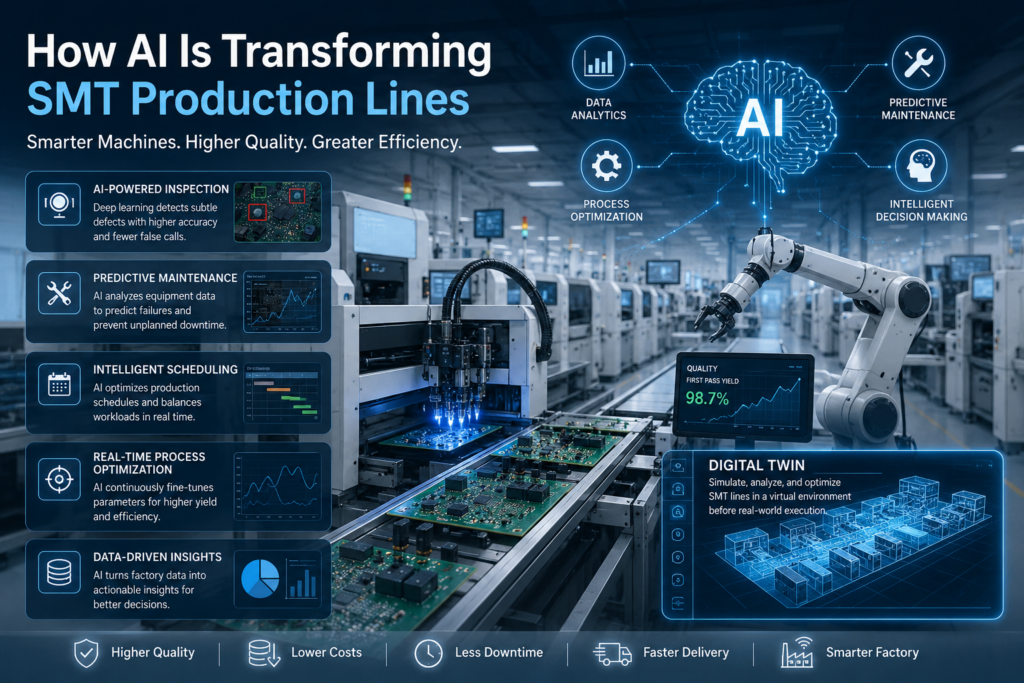
The Surface Mount Technology (SMT) industry is undergoing one of the most significant transformations in its history. Traditionally driven by precision machinery and human expertise, SMT production lines are now being reshaped by artificial intelligence (AI), machine learning, and data-driven automation. These technologies are not only improving efficiency but also redefining quality control, predictive maintenance, and overall manufacturing intelligence.
In this article, we explore how AI is transforming SMT production lines and what it means for manufacturers, EMS providers, and global electronics supply chains.
1. Smarter SMT Production: From Automation to Intelligence
SMT production lines have long relied on automated equipment such as pick-and-place machines, reflow ovens, stencil printers, and AOI systems. While these systems are highly efficient, they traditionally operate based on fixed parameters.
AI introduces a new layer: adaptive intelligence.
Instead of simply executing pre-programmed instructions, AI-enabled SMT systems can:
- Learn from historical production data
- Adjust machine parameters in real time
- Detect anomalies before defects occur
- Optimize line balance dynamically
This shift transforms SMT from “automation-driven” to “intelligence-driven” manufacturing.
2. AI in SPI and AOI: Revolutionizing Quality Inspection
One of the most impactful applications of AI in SMT is in inspection systems such as SPI (Solder Paste Inspection) and AOI (Automated Optical Inspection).
Traditional Limitations
Conventional AOI systems rely on rule-based inspection:
- Fixed thresholds
- Predefined defect libraries
- High false call rates in complex boards
AI Enhancement
AI-powered inspection systems use deep learning models trained on thousands of PCB images. This allows them to:
- Recognize new and unseen defect patterns
- Reduce false positives significantly
- Adapt to different board types without full reprogramming
- Improve inspection accuracy over time
For example, instead of just identifying “missing solder,” AI can classify subtle issues like insufficient wetting, tombstoning risk, or solder joint instability.
This dramatically improves first-pass yield and reduces manual rework.
3. Predictive Maintenance: Preventing Downtime Before It Happens
Unplanned downtime is one of the most expensive problems in SMT production. AI is solving this through predictive maintenance.
How It Works
AI systems continuously analyze data from:
- Motors and actuators
- Nozzle pressure in pick-and-place machines
- Conveyor speed and vibration
- Oven temperature profiles
By detecting early warning signals, AI can predict when a component is likely to fail.
Benefits
- Reduced machine downtime
- Lower maintenance costs
- Longer equipment lifespan
- More stable production scheduling
Instead of reacting to breakdowns, factories can now maintain equipment proactively.
4. Intelligent Production Scheduling and Line Balancing
SMT factories often handle multiple product types with different complexity levels. Traditional scheduling is static and often inefficient.
AI introduces dynamic production optimization.
AI Capabilities in Scheduling
- Automatically prioritizes urgent orders
- Balances workload across multiple SMT lines
- Reduces changeover time between jobs
- Optimizes feeder placement and setup sequences
This results in:
- Higher overall equipment effectiveness (OEE)
- Reduced idle time
- Faster turnaround for small-batch production
For high-mix, low-volume manufacturing environments, this is a game changer.
5. Real-Time Process Optimization in Pick-and-Place Machines
Pick-and-place machines are the heart of SMT lines. AI is making them significantly smarter.
What AI Optimizes
- Component placement accuracy
- Nozzle selection and pressure
- Placement sequence optimization
- Feed rate adjustments based on board complexity
AI systems can analyze thousands of placements per minute and fine-tune parameters on the fly.
For example:
- If misalignment trends are detected, AI adjusts placement coordinates automatically
- If a specific feeder shows inconsistency, the system flags it before failure occurs
This level of micro-optimization was not possible with traditional control systems.
6. Digital Twin Technology for SMT Lines
One of the most advanced AI applications in SMT manufacturing is the digital twin.
A digital twin is a virtual replica of a physical SMT production line.
What It Enables
- Simulating production before actual execution
- Testing line configurations virtually
- Predicting bottlenecks
- Evaluating process changes without downtime
Manufacturers can experiment safely in a virtual environment before applying changes to real production.
This significantly reduces risk and accelerates process improvement cycles.
7. AI-Driven Data Analytics and Decision Making
Modern SMT lines generate massive amounts of data:
- Inspection results
- Machine logs
- Temperature profiles
- Yield reports
AI turns this raw data into actionable insights.
Key Analytics Outputs
- Defect trend analysis
- Yield prediction per product type
- Root cause identification
- Supplier quality tracking
Instead of relying on engineers to manually analyze reports, AI highlights critical issues automatically.
This improves decision-making speed and accuracy at all levels of manufacturing.
8. Workforce Transformation: From Operators to Engineers
AI does not eliminate human roles in SMT production—it transforms them.
Changing Job Roles
- Operators become system supervisors
- Engineers focus on data interpretation and optimization
- Maintenance teams shift to predictive intervention
- Quality teams focus on root cause prevention
The skill set required is evolving toward data literacy, system integration, and AI-assisted decision-making.
Factories that invest in training will gain a significant competitive advantage.
9. Challenges in AI Adoption for SMT Lines
Despite its advantages, AI adoption in SMT is not without challenges:
- High initial investment in smart equipment
- Integration with legacy machines
- Data quality and standardization issues
- Cybersecurity risks in connected factories
- Need for skilled personnel
However, as AI tools become more standardized, these barriers are gradually decreasing.
10. The Future of SMT Manufacturing with AI
The future of SMT production is moving toward fully autonomous smart factories.
We can expect:
- Self-optimizing SMT lines
- Fully automated defect correction systems
- AI-driven supply chain integration
- Lights-out manufacturing (no human intervention)
- End-to-end digital manufacturing ecosystems
In this future, SMT factories will not just produce electronics—they will continuously learn, adapt, and improve themselves.
Conclusion
AI is fundamentally reshaping SMT production lines from rigid automated systems into intelligent, adaptive manufacturing ecosystems. From inspection and maintenance to scheduling and process optimization, AI is improving every layer of the SMT workflow.
For manufacturers and EMS providers, the message is clear: adopting AI is no longer optional—it is essential for staying competitive in a rapidly evolving electronics industry.
Those who embrace AI early will not only improve efficiency and quality but also position themselves at the forefront of next-generation smart manufacturing.
Looking for SMT Production Line Solutions?
We provide:
- New and used SMT machines
- Complete SMT production lines
- PCB assembly solutions
- Yamaha / Panasonic / Samsung equipment
- Global shipping and technical support
Contact us today for professional SMT manufacturing solutions.