
In the world of electronics manufacturing, PCBA (Printed Circuit Board Assembly) is the critical process that brings a bare board to life. If the PCB is the skeleton, the electronic components are the organs and muscles. To attach these components to the board, the industry relies on two foundational manufacturing technologies: SMT (Surface Mount Technology) and DIP (Dual In-line Package, often referred to as Through-Hole Technology/THT).
While SMT has become the dominant method for modern, high-density electronics, DIP remains irreplaceable for specific applications requiring high mechanical strength and power handling. Understanding the differences, advantages, and use cases of each is essential for hardware engineering, sourcing, and supply chain management.
1. What is SMT ?
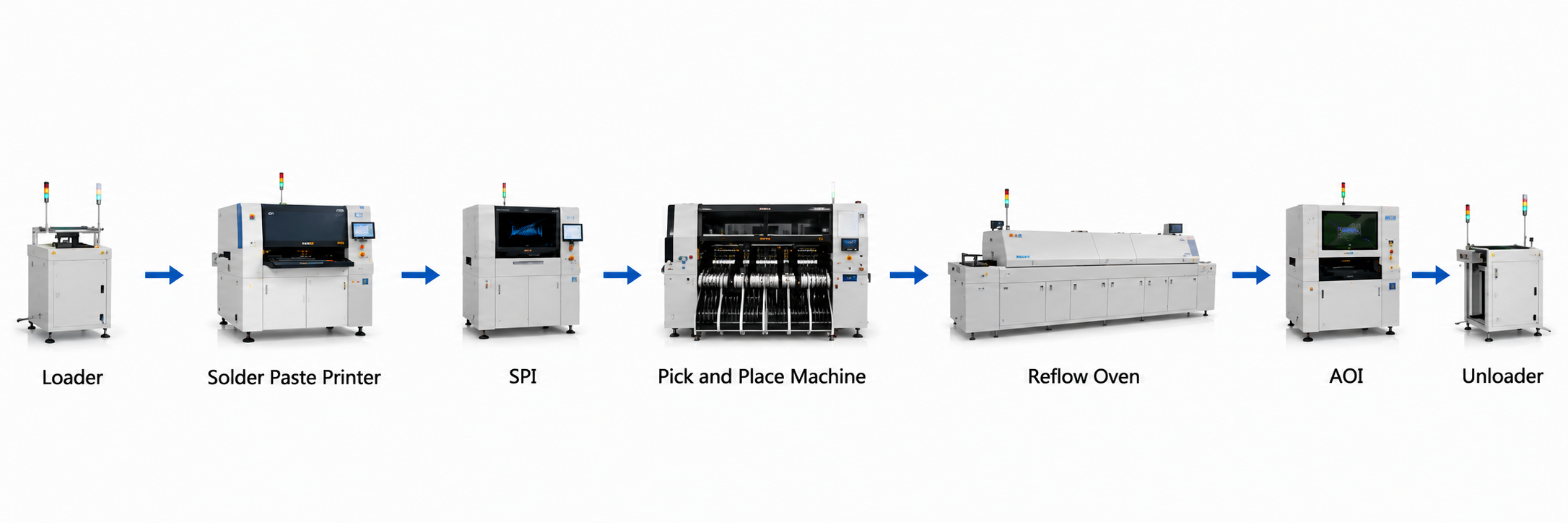
SMT is a method where electronic components are mounted directly onto the surface of the PCB. Unlike older technologies, SMT components (called SMCs or SMDs—Surface Mount Devices) do not have long wires or pins that pass through the board; instead, they have small metal tabs or solder balls that bond directly to flat pads on the board’s surface.
The SMT Process Workflow / SMT 工艺流程:
- Solder Paste Printing: A stainless-steel stencil aligns with the PCB, and a squeegee applies solder paste onto the pads.
- Component Placement: High-speed pick-and-place machines use vision systems to accurately position SMDs onto the wet solder paste.
- Reflow Soldering: The board passes through a multi-zone reflow oven. The heat melts the solder paste, creating permanent electrical and mechanical bonds as it cools.
- AOI Inspection Automated Optical Inspection cameras scan the board for missing components, misalignment, or solder bridges.
2. What is DIP?
DIP, in broader manufacturing terms, represents the traditional Through-Hole Technology (THT). Components used in this process have long leads (pins) that must be inserted into pre-drilled holes in the PCB. Once inserted, the leads are soldered to pads on the opposite side of the board.
The DIP Process Workflow:
- Component Forming & Bending: Component leads are cut and bent to match the precise pitch of the PCB holes.
- Insertion: Factory operators (manual insertion) or specialized machines insert the component leads into the holes.
- Wave Soldering: The board passes over a molten wave of liquid solder. The solder wicks up into the through-holes, securing the pins.
- Lead Trimming & Inspection: Excess lead lengths are trimmed, and the solder joints are inspected manually or via specialized AOI.
3. Key Differences: SMT vs. DIP
To better understand how these two technologies contrast, we can look at them through several critical dimensions:
| Feature | SMT (Surface Mount Technology) | DIP (Through-Hole Technology) |
| Mounting Method | Soldered directly onto the board surface | Inserted into drilled through-holes |
| Component Size | Extremely small (e.g., 01005, 0201 chips) | Larger, bulkier components |
| Assembly Density | High; allows double-sided mounting. | Low; restricted by hole spacing. |
| Mechanical Strength | Lower, sensitive to stress and vibration. | Extremely high, excellent for physical stress. |
| Automation Level | Highly automated, fast throughput. | Often semi-automated or manual. |
| Production Cost | Low at high volumes; high initial setup cost. | Higher per-joint cost; economical for small runs. |
4. Advantages and Limitations
SMT Advantages
- Miniaturization: Because components have no leads and can be placed closer together, PCBs can be significantly smaller and lighter. This is fundamental for smartphones, wearables, and IoT devices.
- Higher Signals & Speed: Shorter paths and fewer holes mean lower parasitic capacitance and inductance, leading to superior RF and high-speed digital performance.
- Cost Efficiency at Scale: Fully automated SMT lines can place hundreds of thousands of components per hour, drastically reducing labor costs for mass production.
SMT Limitations
- Fragile Joints: SMT joints cannot withstand high mechanical stress. Connectors or heavy components attached via SMT may snap off under physical strain.
- Thermal Sensitivity: Densely packed components require advanced thermal management (heat sinks, thermal vias) to prevent overheating.
DIP Advantages
- Extreme Durability: The solder fill inside the through-hole creates a robust bond. DIP is the choice for components that will experience continuous mechanical pulling, pushing, or high vibrations (e.g., industrial switches, power terminals).
- High Power & Voltage Handling: Heavy-duty components like large transformers, power transistors, and electrolytic capacitors require the thick leads and solid connections that only DIP can offer.
- Easy Prototyping: DIP components are compatible with breadboards and manual soldering, making them ideal for initial R&D testing and repairs.
DIP Limitations
- Space Inefficiency: Drilled holes must penetrate all layers of the PCB, consuming valuable routing space even on internal layers, preventing high-density routing.
- Slower, Labor-Intensive: Wave soldering and manual plug-ins make DIP lines significantly slower and more labor-reliant than SMT.
5. Conclusion: The Hybrid Reality of Modern Manufacturing
In modern hardware manufacturing, it is rarely a strict choice of SMT vs. DIP. Instead, the vast majority of consumer, industrial, and automotive electronics utilize a hybrid assembly line.
Typically, a PCB will go through the SMT reflow process first to populate the millions of tiny resistors, capacitors, and microprocessors. Afterward, the board moves to the DIP section where human operators or selective wave soldering machines install the heavy transformers, power connectors, and external ports.
By strategically leveraging the high speed and density of SMT alongside the rugged reliability of DIP, manufacturers can build electronic products that are both incredibly smart and exceptionally durable.
Looking for SMT Production Line Solutions?
We provide:
- New and used SMT machines
- Complete SMT production lines
- PCB assembly solutions
- Yamaha / Panasonic / Samsung equipment
- Global shipping and technical support
Contact us today for professional SMT manufacturing solutions.